The history of Chardonnay
A Burgundian village name, an unlikely peasant parent, and one afternoon in Paris that remade California wine.
No grape has traveled like Chardonnay. It grows on six continents, anchors the most expensive whites on earth and some of the cheapest, and turns up on tasting lists from Champagne to this valley. Yet the whole global empire traces back to a stretch of small walled hills in eastern France — and to a family secret that stayed hidden until DNA testing pulled it into the light at the end of the twentieth century.
The story runs in three acts: Burgundy, where the grape got its name and its manners; Paris, 1976, where one blind tasting broke Burgundy’s monopoly on prestige; and the long westward sweep that planted it, eventually, in Temecula granite.
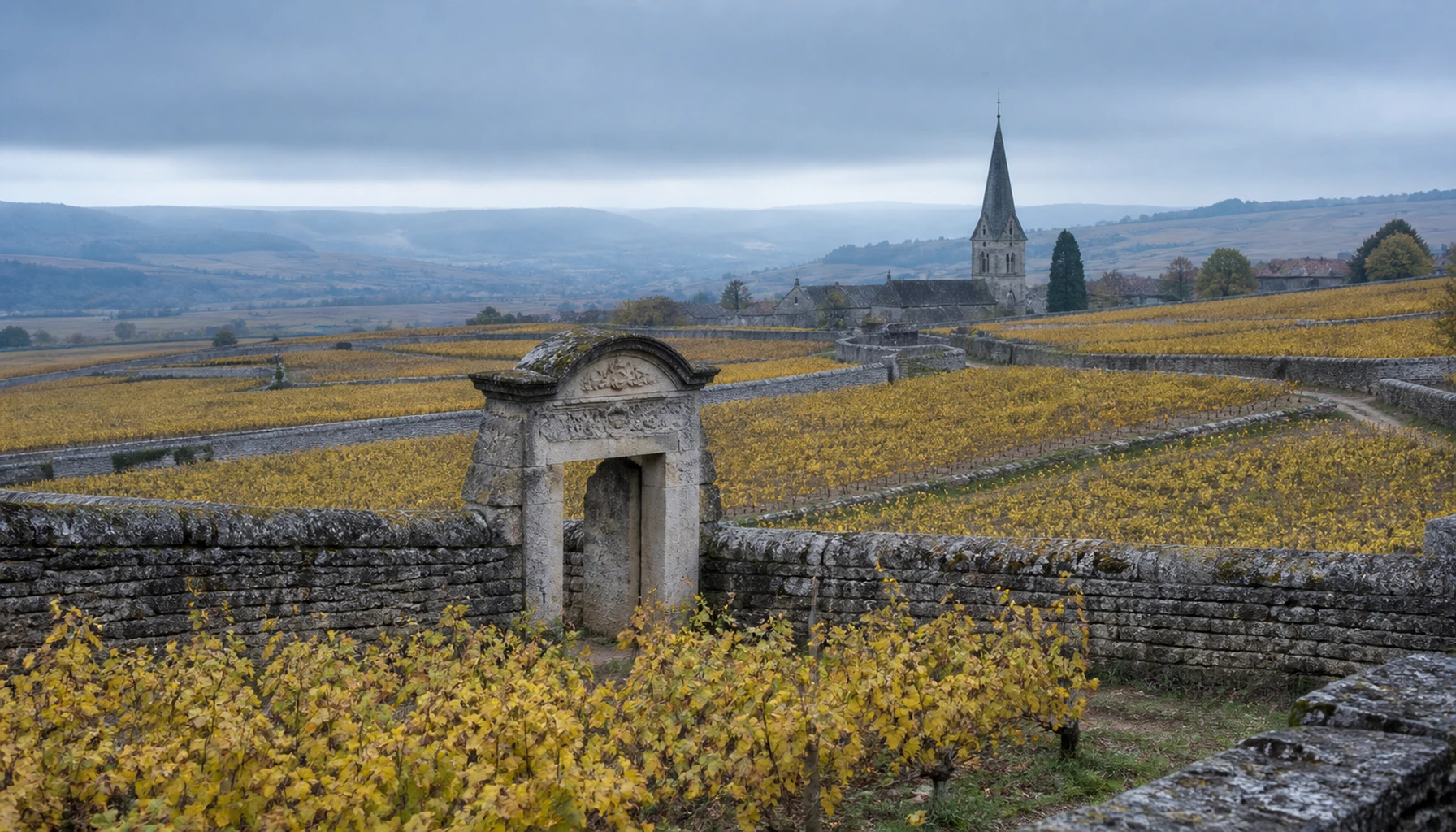
Burgundy, name and birthplace
A village small enough to miss, a parentage nobody saw coming.
Drive the Mâconnais in southern Burgundy and you will pass, without ceremony, a village called Chardonnay. The grape almost certainly carried the name outward from country like this — and for centuries that was all anyone knew of its origins. Then DNA work at UC Davis in the late 1990s produced one of wine science’s best plot twists: Chardonnay is a cross of Pinot, the aristocrat of Burgundy, and Gouais Blanc, a peasant grape so lowly that medieval authorities tried more than once to ban it. The same unlikely marriage produced a whole litter of siblings — Aligoté and Gamay among them — making the world’s poshest white the child of a grape nobody would admit to growing.
Burgundy then spent centuries — monks, dukes and vignerons walling and mapping the slopes vine by vine — demonstrating the grape’s range. At Montrachet, on the Côte de Beaune, it makes whites of golden, honeyed grandeur; downriver in Chablis, on limestone seeded with fossil oyster shells, the same grape comes back lean, flinty and sea-cold. And in Champagne it learned its third trade: Chardonnay is the backbone of blanc-de-blancs sparkling wine, made by the méthode champenoise that three Temecula houses still practice on site. One grape, three completely different careers — the canvas showing its colors early.
The afternoon the map changed
French judges, brown-bagged bottles, and a verdict nobody in the room expected.
In May 1976, a British wine merchant named Steven Spurrier sat a panel of eminent French judges down in Paris to taste California wines blind against the best of France — a publicity exercise, most assumed, with a foregone conclusion. The scores said otherwise. When the white flight was tallied, the top wine was a California Chardonnay — Chateau Montelena’s, from Napa — ranked above the white Burgundies it had impersonated so successfully. (The reds went California’s way too.) The Judgment of Paris did not make French wine worse or California wine better; it simply proved, with French signatures on the scorecards, that geography was no longer destiny. California believed it instantly, and planted Chardonnay everywhere.
California’s grape, the valley’s corner
The sweep, the backlash, and the seat it never gave up here.
What followed was the great sweep: through the 1980s and 1990s Chardonnay became the default white of the wine-drinking world, planted from Australia to Chile, its name practically a synonym for “a glass of white.” Ubiquity bred its own backlash — the “Anything But Chardonnay” crowd of the 1990s, in full revolt against the toastiest, butteriest examples — and then the pendulum settled where it usually does, with both the lean school and the golden one in honest production. Most strong opinions formed in that era were, as ever, opinions about oak.
Temecula’s chapter is quieter and steadier. The classics — Cabernet, Merlot, Zinfandel, Chardonnay — never left this valley, and while later fashions brought the Rhône, Italian and Spanish benches to the granite, Chardonnay simply kept its seat — warm vintages keep it generous, round and ready young, and it holds its corner on lists around the valley. For the history poured alongside it, start at Callaway, the valley’s first commercial winery, in business since 1974 — two years before Paris changed everything for California Chardonnay.
Featured videos
From Burgundy’s villages to a Paris tasting room — the historians pour the long version.
Taste the classic
The varietal page covers the sunny style Temecula makes, the oak question decoded, and where to taste the grape that survived its own fame — starting with the house that has poured it here the longest.