The history of Zinfandel
California’s most Californian grape spent a hundred and fifty years declining to say where it was born.
Every other great grape carries its homeland in its name or its legend — Cabernet has Bordeaux, Syrah has its Rhône hillsides, Sangiovese has all of Tuscany. Zinfandel arrived in America already separated from its papers: a vine with a name no European vineyard used, a past nobody could produce, and a future that turned out to be the whole story of California wine in miniature.
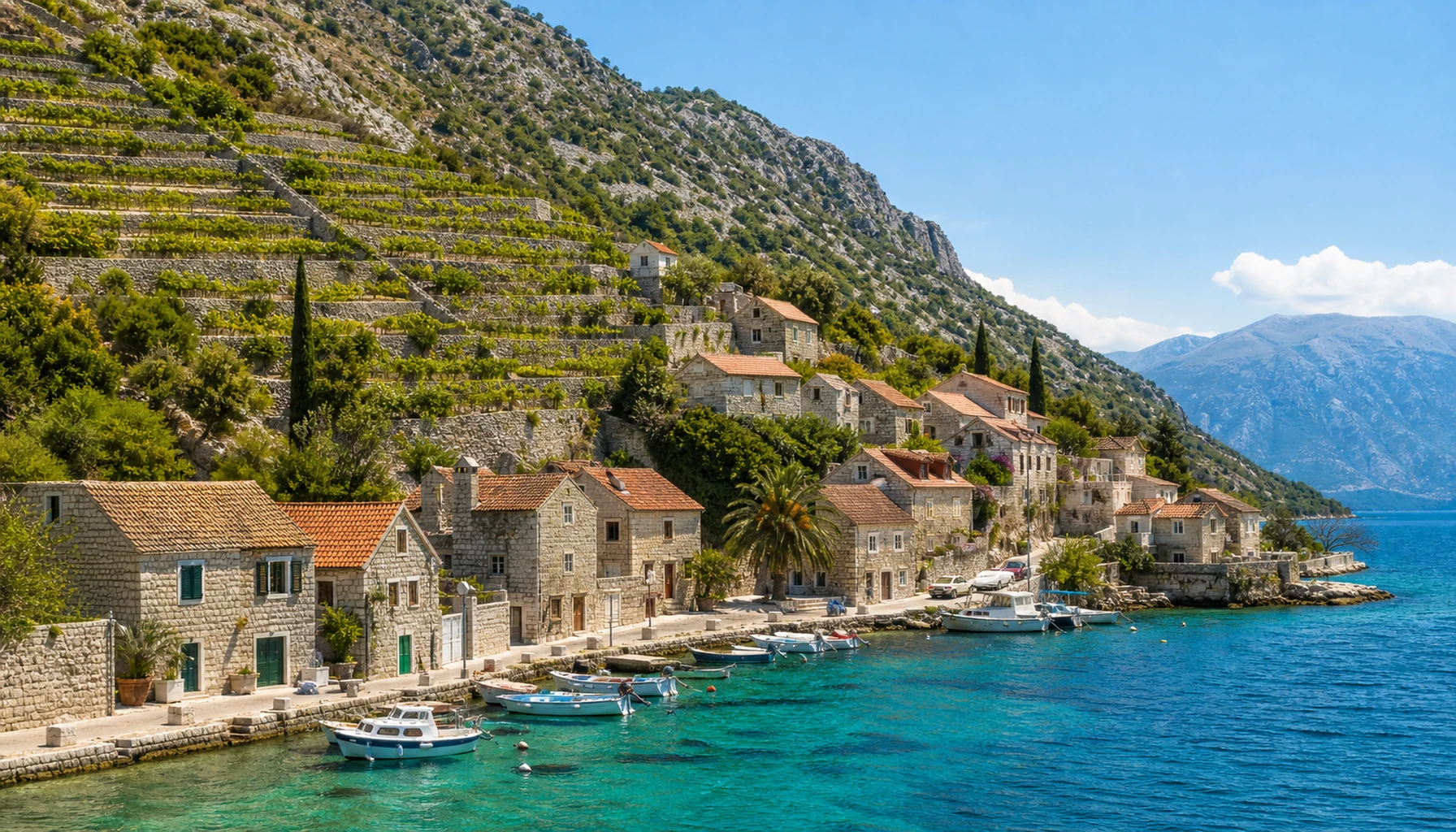
Solving the mystery took botanists, a suspicious resemblance in the heel of Italy, and finally a DNA lab — and the trail ends, of all places, on the stone terraces of the Croatian coast. It is the best detective story in American wine, and it runs like this.
A grape without papers
From an imperial plant collection to an American nursery catalog — and then a century of dead ends.
Out of the imperial nurseries
The vine reached the United States in the 1820s and ’30s by way of East Coast nurseries drawing on the plant collections of the Austro-Hungarian empire — sold at first as a novelty, even grown under glass as a table grape. Somewhere in transit it acquired the name Zinfandel, which corresponds to no grape in Europe; the best guess is a garbled borrowing from an Austrian variety that turns out to be no relation at all. The vine thrived; the paperwork was already lost.
The Puglian double
The first real break came generations later, when Zinfandel and Primitivo — the workhorse red of Puglia, down in Italy’s sun-hammered heel — were recognized as one and the same grape. A clue as much as an answer: Italy had clearly received the vine rather than birthed it, but the company it kept was telling. Wherever this grape began, it gravitated toward heat.
Tribidrag
The verdict finally arrived in 2001, when DNA work matched both Zinfandel and Primitivo to Crljenak Kaštelanski — known in older records as Tribidrag — a nearly extinct variety surviving as a handful of vines on Croatia’s Dalmatian coast. After some 180 years of aliases, the grape had a birthplace: sun-struck stone terraces above the Adriatic, about as far from a Gold Rush boomtown as a vine could imagine.
Gold rush to pink accident
The grape that watered the Gold Rush was later rescued by, of all things, a stuck fermentation.
Gold made the grape’s American career. When the Rush filled California with thirsty newcomers, Zinfandel proved the vine for the moment — vigorous, heat-loving, generous in the barrel — and it boomed into the young state’s workhorse red. The century that followed left California its gnarled inheritance of old Zinfandel vineyards, some of the oldest wine vines in the country, planted by people who never learned where their grape was from and never needed to.
By the 1970s, though, old workhorse vineyards were exactly the kind of land that gets replanted — until the accident. In 1975, a pale, pink Zinfandel at Sutter Home stuck partway through fermentation and kept its natural sugar, and the resulting sweet blush — White Zinfandel — sold beyond anyone’s reckoning. Commercial indispensability turned out to be the best preservation order ever issued: the pink accident kept acre after acre of old red-wine vines in the ground. The full pink story, and how to tell sweet from dry at the bar, lives on the rosé page.
Temecula’s part is the quiet coda: Zinfandel is one of the classics that never left this valley, and the local climate argues its case — a grape born on hot Adriatic stone and raised in the Gold Rush sun finds nothing to complain about on warm decomposed granite. It shows up on lists around the valley, ripe and unembarrassed, three names and two continents behind it.
Featured videos
Nursery catalogs, gold country, a Dalmatian cliffside and a stuck ferment — wine’s best detective story, on film.
Case closed
Croatian by birth, Puglian by coincidence, Californian by unanimous consent — the argument was settled in the glass long before the lab weighed in.