How wine came to the valley
Most wine regions measure their history in centuries. Temecula’s fits inside a single lifetime — and some of the first names are still on the doors.
Every wine region has an origin story, and most need dynasties to tell it. Temecula runs from cattle to Cabernet within living memory: in 1968 this was still working rangeland, and the people who thought it should be wine country were nearly alone — granite hills an hour from the coast, went the sensible objection, could never ripen wine grapes properly. Fifty-some tasting rooms now file their disagreement every afternoon of the week.
This page is the biography of the ground under your glass: a name older than any rancho, a century of cattle, a master-planned bet, a first winery whose white found its way to a queen, federal papers, a plague — and the replant that turned disaster into the valley’s modern Mediterranean identity. Pour something local and start at the beginning.
The place of the sun through the mist
The oldest name on the map describes the exact weather that would one day make the wine possible.
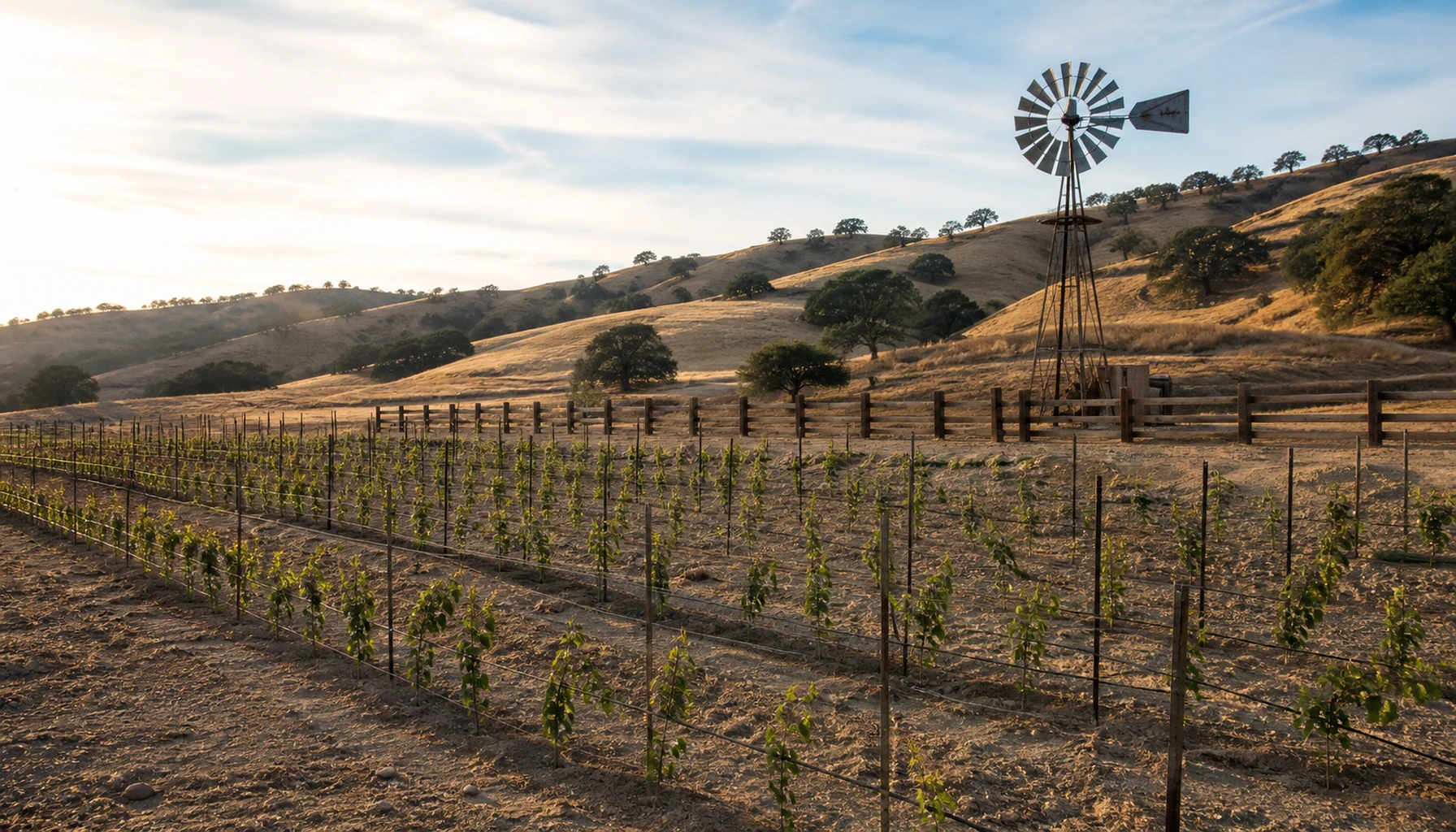
The valley’s name is far older than its wine. This was — and is — Luiseño country: the Pechanga people have called the valley home for countless generations, and “Temecula” is usually glossed from their language as “place of the sun through the mist” — meteorology as much as poetry. Marine air slides in from the Pacific through the Rainbow Gap, hazes the valley floor overnight, and burns off into hard blue by mid-morning: the same nightly cooling that now lets wine grapes keep their nerve through a hot inland summer. The people who named the place named its mechanism.
For the century before the vines, though, the valley’s business was cattle. The rancho era carved it into grazing country, and by the twentieth century most of it had been gathered into one enormous operation — the Vail Ranch. Wine appeared nowhere in the plan. The plan, for a hundred years, was beef.
Rancho California, 1964
A cattle empire sold to a master plan — and the master plan went looking for farmers.
In 1964 the ranch sold, and the old rangeland was reborn on paper as Rancho California — a planned development with ambitions beyond house lots. The planners went recruiting for agriculture, and the climate charts made an argument nobody local had thought to make: high elevation, fast-draining decomposed granite, hot days with a built-in ocean cooling system arriving through the gap every evening. On paper, the cattle country read like the Mediterranean. On paper, it could grow wine.
The believers arrived almost immediately. Vincenzo and Audrey Cilurzo planted in 1968, among the valley’s first commercial vines. A year later Ely Callaway — a textile executive then, the golf-club name later — put in his own vineyard, and 1969 also saw the first plantings at Mount Palomar, which in Temecula terms is as close to the beginning as a working winery gets. None of them had proof. That was rather the point.
The house that went first
Planting vines is a theory. Selling wine — and pouring it for a queen — is proof.
In 1974, Callaway opened the valley’s first commercial winery, and its early whites did the improbable work of making an unknown region’s name. The standard telling gives the young valley its crowning moment in 1976, when a Callaway white was poured for Queen Elizabeth II — publicity a five-year-old wine region could not have bought at any price. The bet paid, the rest of the road followed, and half a century later the tasting bar at Callaway still carries the easy confidence of the house that went first.
Federal recognition took another decade. In 1984 the valley was granted its own American Viticultural Area — the government’s formal acknowledgment that these 33,000 acres grow wine distinct enough to deserve their own name on a label. The paperwork said “Temecula”; a 2004 amendment renamed it “Temecula Valley,” which is what everyone had been calling it anyway.
The sharpshooter years
At the end of the 1990s the young valley nearly died — and the recovery accidentally invented the one you visit.
Pierce’s disease is a bacterium that chokes off a grapevine’s water supply; there was no cure then and there is none now. In the late 1990s it arrived in the vineyards aboard an invasive insect called the glassy-winged sharpshooter and moved through the valley like a slow fire. A large share of Temecula’s vines died. For a wine region barely thirty years old, it was an existential question, asked in public, one browning row at a time.
The valley answered by replanting — and replanting smarter. Where the first era had leaned on the famous classics, the replant planted for the actual climate: Rhône reds and whites, Italian and Spanish varieties, the Mediterranean grapes that want exactly what the valley has — hot days, marine-cooled nights, granite that drains fast. What looked like the end became the founding of Temecula’s second identity. The lists you read today — Syrah and Viognier up front, Tempranillo earning its reputation, a whole Italian wing — were drafted, in a real sense, by an insect.
Featured videos
Rangeland to wine country in one lifetime — the valley’s story told on film. Press play, pour something local, settle in.
Fifty doors and counting
Today some fifty wineries pour across the valley: founding estates and resort campuses along Rancho California Road, family cellars strung down the De Portola Trail, garage-scale obsessives out where the pavement narrows. The mornings belong to hot-air balloons drifting over the vines before the rooms open, and the story keeps hiring — newer rooms arrive with something to prove, and the next generation gets to skip the part where nobody believes the valley can do it.
Best of all, a history this short is still entirely tastable. The replant’s whole argument sits on the lists — the reds the disaster made room for, the whites that carry the heat with grace — and an afternoon of tasting walks you through all of it, 1968 to now, five or six glasses at a time. None of it is old enough to be anybody’s legend yet. Go taste it while the founders’ names are still on the signs.