The history of Viognier
From a dozen dying hectares above the Rhône to nearly every tasting list in Temecula — the flagship white’s comeback story.
Grape histories usually move at the pace of empires — centuries of slow spread, dynasties of growers, the occasional papal endorsement. Viognier’s story turns instead on a few decades in the middle of the twentieth century, when the entire world supply of this grape shrank to a handful of terraces above a bend in the Rhône and very nearly blinked out. Everything poured under the name today, Temecula’s flagship white included, descends from that near miss.
So this page is really three stories: a steep and stubborn homeland, a rescue that arrived barely in time, and a westward leap that gave the grape more ground in California than it ever held in France.
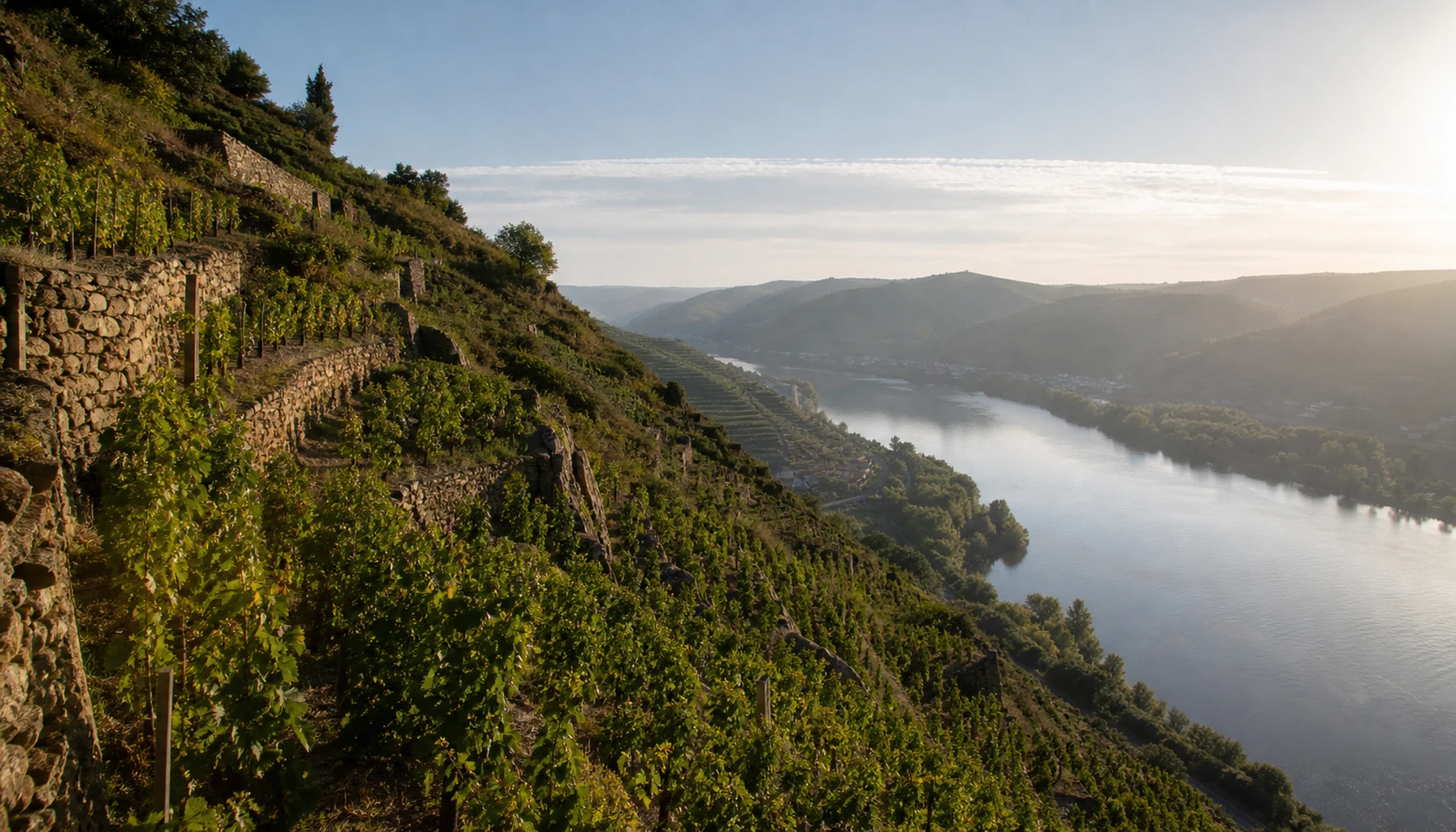
Condrieu, a few steep miles
One grape, one bend of one river — and slopes so steep the vines are worked by hand.
Viognier’s homeland is the northern Rhône, just south of Lyon, where the river swings past the village of Condrieu and the granite rises almost straight out of the water. The vineyards hang on terraces held up by dry stone walls, too steep for machines, farmed the hard way for as long as anyone has farmed them. Condrieu grows Viognier and nothing else in white, and tucked inside its slopes sits Château-Grillet — a single estate with an appellation entirely to itself, one of the smallest in France. The romantic version of the origin story credits the Romans with planting the first vines here; the paper trail is thinner than the legend, but the terraces themselves argue for a very long habit.
The grape also earned a second, stranger job a few miles upstream in Côte-Rôtie, where growers have long planted it among their Syrah and fermented the two together — the rules allow up to a fifth Viognier, most use a splash — because the white grape deepens the red’s color and lifts its perfume. A white wine improving a red is the kind of paradox the Rhône enjoys.
Then came the long fall. Phylloxera gutted the vineyards in the nineteenth century, two wars emptied the villages in the twentieth, and the brutal arithmetic of hand-worked terraces did the rest — easier livings waited down on the plain, and hillsides this steep are only farmed by people with a reason. By the 1960s Condrieu was down to roughly a dozen planted hectares. Call it thirty acres: the world’s entire meaningful supply of Viognier, awaiting deletion like a footnote.
Rescue, then California
The wine world thought better of it — and the New World gave it more ground than it ever held at home.
The rescue came from a handful of stubborn Condrieu growers who kept farming the terraces through the lean decades, and from a wine world that finally caught up with what it was about to lose. Through the 1980s and 1990s critics rediscovered Condrieu, prices climbed to match the labor, and the abandoned walls filled back in with vines. A grape that had been a curiosity for specialists became, in one generation, one of the most fashionable whites in France.
California was watching. The loose confederacy of growers and winemakers who came to be called the Rhône Rangers had spent those same years arguing that the state’s warm hillsides had more in common with the Rhône than with Burgundy or Bordeaux — and Viognier, a sun-loving white on the verge of vanishing, made their case for them. Cuttings crossed the ocean, plantings spread, and in time it became California’s most planted white Rhône variety: a grape with more acreage in its adopted country than it ever held in its own.
Temecula is the logical end of that migration. A warm granite valley with marine-cooled nights offers exactly the employment Viognier wants — full ripeness with the freshness intact — and the valley made the grape its flagship white. It shows up on nearly every list here, and Rhône-leaning houses like Miramonte have made varieties like this one the house cause. Not bad for thirty acres of footnote.
Featured videos
Condrieu’s terraces, the near-extinction, the revival — the grape’s biographers take the story from here.
Taste the comeback
History is better with a glass of the subject in hand. The varietal page covers what Viognier tastes like, how cold to pour it, and where the valley does it proudly — and the survivor of Condrieu’s terraces is waiting on nearly every list in town.