The history of Vermentino
A biography written by sailors — islands, coasts, four names, and a sea that kept no records.
Most grape histories follow rivers and monasteries: monks kept ledgers, and ledgers keep names. Vermentino’s history follows shipping lanes instead, and sailors kept worse records. The grape surfaces in accounts around the western Mediterranean — Liguria’s terraces, the big islands, the coasts between — without ever quite announcing where it started. The long-standing assumption has it traveling the sea routes from Spain, or from Liguria, depending on which coast is telling the story.
What the record does show, everywhere the grape appears, is a consistent taste in real estate: hard, sunny, wind-scoured hillsides within sight of salt water. Follow that preference across a thousand years of coastline and you have the map of Vermentino — and, skipping ahead a few centuries, a fair sketch of a certain granite valley in Southern California.
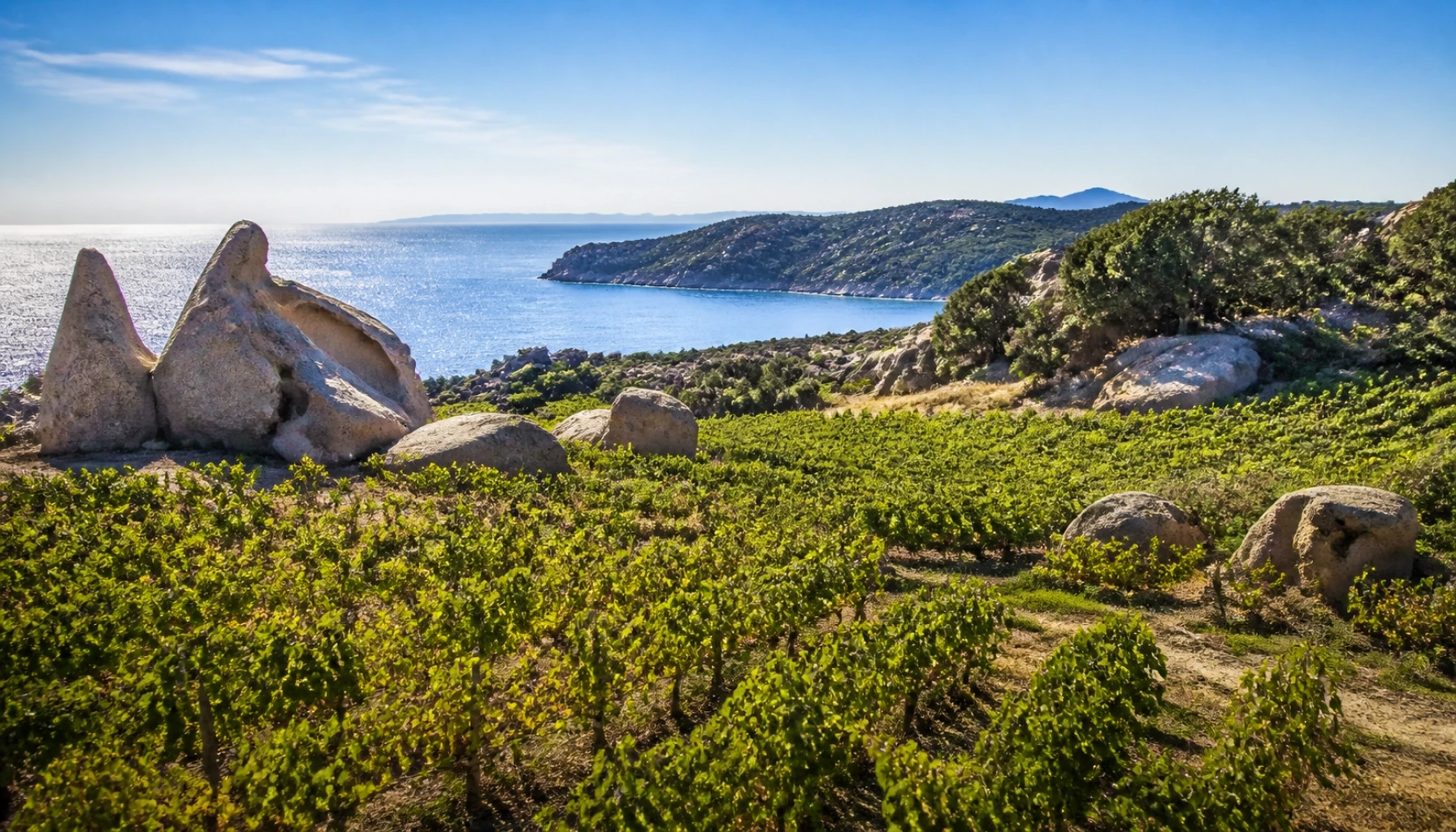
Sardinia & Corsica
Two islands, one grape, and the granite country where it turns serious.
Sardinia is where Vermentino carries the most weight. In Gallura, the island’s wind-carved granite northeast, the grape concentrates into something with real spine — riper, stonier, longer — and the region’s standing was made official in 1996, when Vermentino di Gallura became the island’s first and only DOCG, the top tier of Italian wine law. One grape, one appellation, granite underfoot: Sardinia decided what its flagship was and has never wavered since.
Corsica, a strait away, tells the French half of the same story. As Vermentinu it is the island’s defining white, grown amid the maquis — the dense, resinous scrubland whose crushed-herb smell drifts into every honest description of the wine. Same grape, same sea, different flag; on both islands it tastes of sun on stone and herbs on the wind.
Liguria, Piedmont & the coasts
Terraces over the sea, a freckled alias, and the DNA work that merged three grapes into one.
On the Ligurian coast — the crescent of terraced hillside running toward France — the grape goes by Pigato, a name usually read as local dialect for “freckled,” after the spots its ripe berries wear there. Down the Tuscan coast, the Maremma took the grape up under its own name; across the French border, Provence blends it as Rolle; and inland Piedmont grew it for generations as Favorita. For centuries these read as a family of similar local whites — until DNA work showed Pigato, Favorita and Vermentino to be a single grape wearing local names, a passport of aliases collected port by port.
Which leaves the origin question exactly where the sailors left it: unsettled. Spain or Liguria, east or west — the honest answer is that the grape belongs to the sea lanes themselves, and every coast that ever landed it considers itself the homeland. Wine has founding myths in far worse repair.
New coasts, same instincts
A heat-and-salt résumé travels well — and Temecula’s granite reads like home.
A grape that shrugs at drought, ripens late, and keeps its freshness through hot summers is exactly what warm New World regions go shopping for, and Vermentino has been finding second homes accordingly — warm corners of Australia and California among them. It travels the way it always has: by suitability, sunbaked coast to sunbaked coast.
Temecula’s chapter belongs to its Italian houses. Cougar planted its vineyard for the Italian varieties and declined to hedge, whites included; Mount Palomar has leaned Italian on plantings in the ground since 1969, close to the valley’s beginning; and Robert Renzoni brings four generations of instinct to the southern trail. Between them the grape thrives here — hot days, cool marine evenings through the Rainbow Gap, decomposed granite underfoot. Whether that granite is coincidence or casting, the grape that made its most serious wine on Gallura’s stone appears to have noticed the resemblance.
The tasting particulars — the almond tell, the serving temperature, the three doors to try first — live on the varietal page.
Featured videos
Sardinia, Gallura, and the granite coast — the grape’s home waters, on film.
Taste the voyage
A thousand years of coastline, available by the flight. The varietal page carries the styles, the serving, and the three Italian doors to start with; the rest of the valley’s whites are one step back up the road.