The history of Sauvignon Blanc
A grape named for wildness, with two homelands, one famous child, and a late reinvention at the bottom of the world.
Start with the name. Sauvignon is usually traced to sauvage — French for wild — most likely a comment on the vine itself, a vigorous, unruly grower that behaves as though it has somewhere better to be. Blanc handles the rest. A wild white, then; and everything the grape has done since — the flint, the cut grass, the acid with its elbows out — has honored the label.
Most great grapes have one homeland. Sauvignon Blanc kept two for as long as records reach — the chalk-and-flint hills of the upper Loire and the blending cellars of Bordeaux — and then, within living memory, added a third that changed how the entire world says its name. What follows is that story, including the part where a white grape quietly fathered the most famous red on earth.
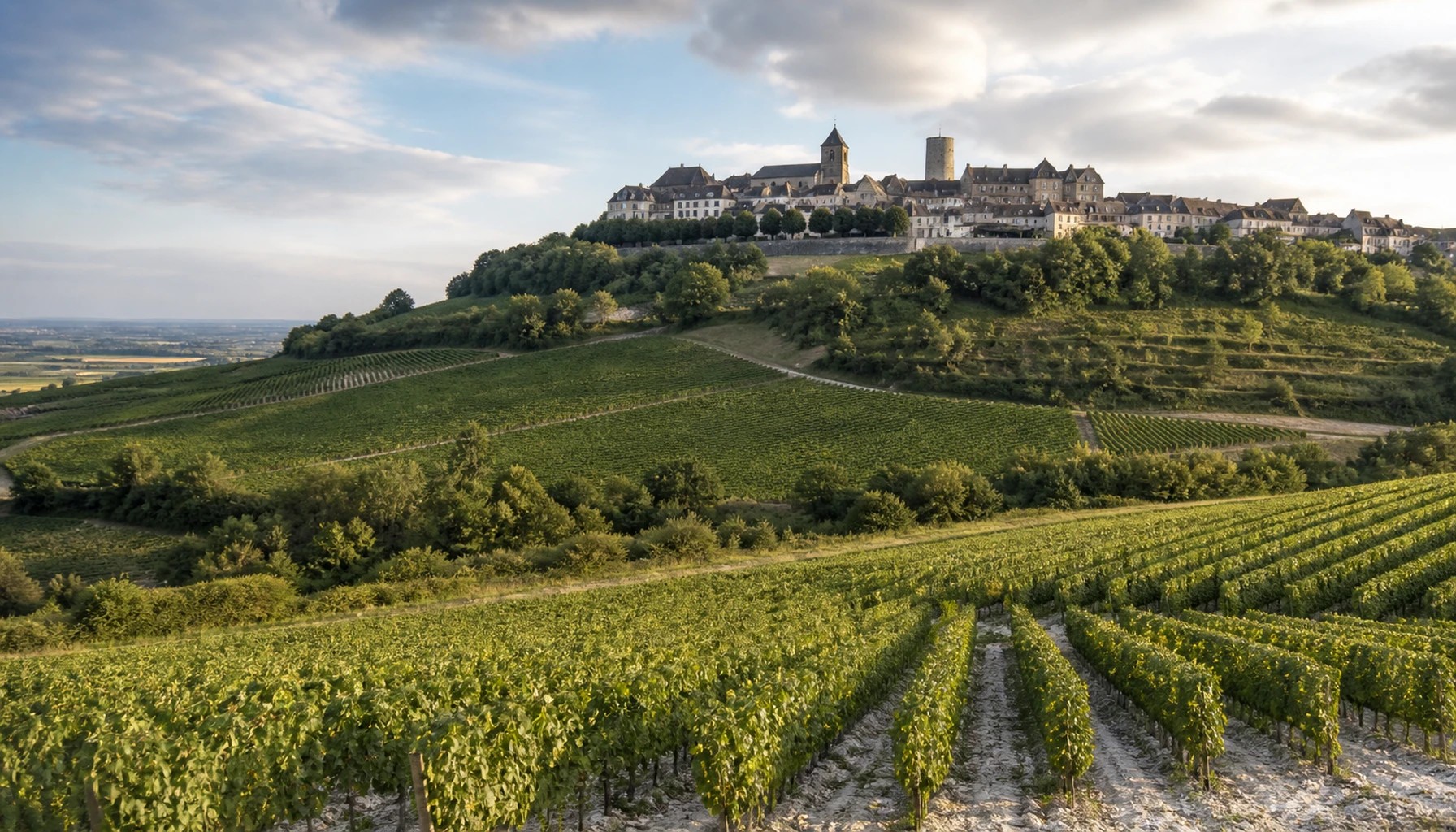
Flint country
Two towns stare at each other across the river — and set the standard the world still measures against.
In France’s upper Loire, Sancerre sits on its hilltop and Pouilly-Fumé answers from the far bank. Both built their names on Sauvignon Blanc grown over chalk, limestone, and bands of flint, and both bottle it the same austere way: bone-dry, unoaked, nothing standing between you and the grape. Citrus, blackcurrant leaf, and a mineral edge tasters have always sworn smells of struck flint — the fumé in Pouilly-Fumé means smoked, and the smoke is in the glass, not the cellar. The grape itself long traveled here under the local name Blanc Fumé, a detail that will matter again in California.
The region also settled one of wine’s surest table pairings without appearing to try: the goat cheese of Chavignol, a village inside Sancerre’s own vineyards, beside the local white — acid against cream, resolved centuries ago. And for most of its history, that was the grape’s ceiling: a local hero, adored on its own hills, obscure nearly everywhere else.
The other homeland — and the famous child
In the southwest it learned to share — and made history nobody noticed for three hundred years.
Bordeaux taught the grape teamwork. In the region’s dry whites it partners Sémillon — Sauvignon the nerve and lift, Sémillon the wax and weight — and in Sauternes the same pair meets noble rot to make one of the world’s great sweet wines, Sauvignon’s acidity holding all that honeyed richness upright. Two jobs, both supporting roles, both essential — the grape has never minded sharing a bill.
Then the twist. In 1996 and 1997, DNA fingerprinting at UC Davis established that Cabernet Sauvignon — Bordeaux’s flagship, the most celebrated red grape alive — is a chance seventeenth-century cross of Cabernet Franc and Sauvignon Blanc. Nobody planned it; some Bordeaux vineyard simply stood two vines close enough together, and three centuries later the accidental child had outgrown both parents. Any taster who finds a green, leafy note in a young Cabernet is tasting the family resemblance.
Marlborough turns the volume up
Centuries of French restraint, undone — gloriously — in about a decade.
The modern era begins at the bottom of the world. The first vines went into New Zealand’s Marlborough region in the 1970s, on the theory that the South Island’s long, cool ripening season might suit the grape. It did more than suit it. Marlborough turned Sauvignon Blanc’s volume all the way up — passionfruit, gooseberry, cut grass at broadcast strength — and as labels like Cloudy Bay traveled through the 1980s, the world’s idea of the grape flipped in a single generation. The boom made Marlborough famous, and it made Sauvignon Blanc a global habit.
California’s chapter came with a rebrand. The grape was already in the state’s vineyards, but it sold slowly until Robert Mondavi, in the late 1960s, renamed his dry, barrel-aged version Fumé Blanc — borrowing Pouilly’s smoke, and proving that a French accent moves cases. The alias still marks California lists today, and it is the same grape in a dinner jacket.
In Temecula, Sauvignon Blanc plays the part described on its own page: supporting cast behind Viognier’s flagship — kept by a handful of houses, absent from plenty of good lists, and worth ordering the moment you spot one. Warm-country Sauvignon runs sunnier than Sancerre and quieter than Marlborough, with the acid line intact — which, on a ninety-degree tasting afternoon, is the entire argument.
Featured videos
Sancerre, the Loire, and the grape’s first kingdom — the old world, on film.
Taste where it landed
History reads better with a glass in hand. The varietal page covers the three great styles, the serving temperature, and the Temecula hunt — and the rest of the valley’s whites are one step back up the road.