The history of Syrah
Persia said one legend, a crusader’s hill said another — and in 1998 a DNA lab beat them both with the truth.
Every famous grape accumulates stories, and Syrah collected better ones than most. For two centuries, drinkers repeated them over the world’s darkest glass: that the vine had marched west from ancient Persia, or sailed from Sicily, or come home from the Crusades in a knight’s saddlebag. The real biography — assembled by geneticists within living memory — turned out to be homelier than any of the legends, and prouder.
It runs from two forgotten country grapes in the French hills, up the steepest terraces of the northern Rhône, out through an Australian rebranding — and ends, for our purposes, on decomposed granite twenty-two miles from the Pacific.
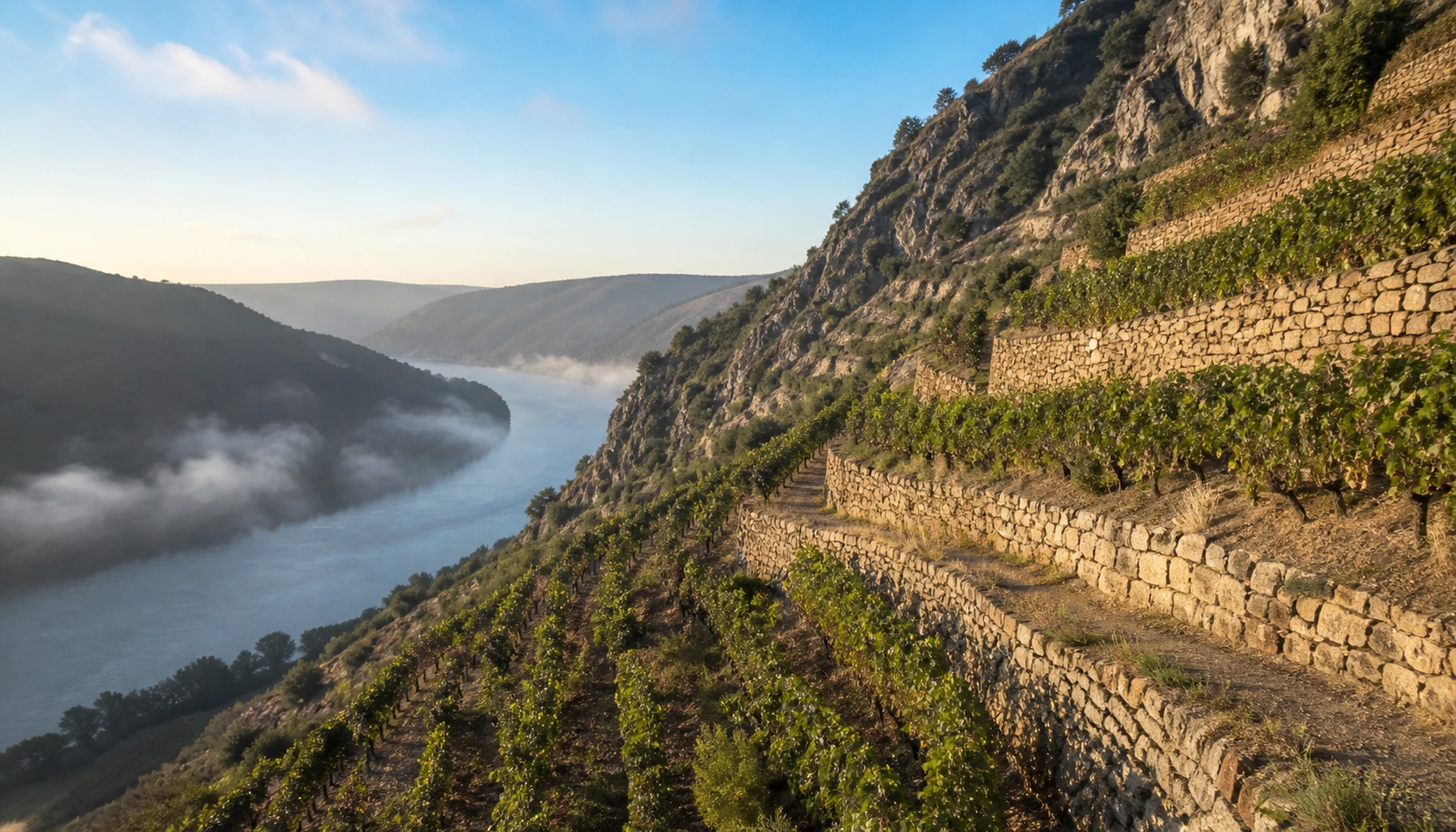
A hill above the river
A short stretch of the northern Rhône, worked by hand, made this grape’s reputation.
Syrah earned its name on a few miles of riverbank where the Rhône bends and the granite tilts into slopes so steep they are still farmed on foot, terrace by terrace. Two small appellations did most of the arguing: Hermitage, a single hill crowned with a stone chapel, and Côte-Rôtie — literally the “roasted slope.” The wines they sent downriver were black, peppery and famously long-lived, and for centuries they ranked with the most expensive in France. All of it from one grape, grown nearly nowhere else.
A wine that good demanded an origin story to match, and it got several. The chapel gave Hermitage its hermit — a crusading knight, the tale went, who came home from the wars and spent his last years planting vines on the hill. And the name did the rest: say “Syrah” within earshot of “Shiraz” and the grandest legend of all writes itself — a vine carried west from Persia’s fabled wine city. Books repeated it as fact well into the twentieth century.
1998: the laboratory rules
No caravan, no crusade — a natural cross of two grapes nobody had heard of.
In 1998, DNA typing at UC Davis, working with researchers in Montpellier, settled the question in a paragraph. Syrah is a natural cross of Dureza, a rustic red of the Ardèche, and Mondeuse Blanche, a modest white of Savoie — two obscure French country grapes whose own home villages had all but stopped growing them. The vine was born within reach of the hills that made its child famous. The Persia legend died on the spot, and a better story took its place: aristocracy out of peasant stock, twice-forgotten parents with an immortal son.
By then the grape had long since acquired a second passport. In 1832, James Busby shipped his famous collection of European vine cuttings to Australia; Syrah took to the new country immediately, kept the old myth as a stage name — Shiraz — and grew into Australia’s national red. One grape, two names, and the wine world has been happily confusing newcomers with the pair ever since.
To California, to Temecula
The Rhône Rangers made the argument; a warm granite valley keeps making it.
California’s Rhône moment arrived in the 1980s, when the growers who called themselves the Rhône Rangers argued that the state’s warm, stony hillsides had more in common with the Rhône than with Bordeaux — and planted accordingly. Syrah rode at the front of that movement, and the valleys that suited it best were the ones that could ripen the grape fully without cooking away its savory half.
Temecula makes the case neatly. Long hot days ripen Syrah’s tannin all the way to velvet; the nightly marine air through the Rainbow Gap keeps the pepper and smoke in the fruit; the decomposed granite drains like the old-world hillsides the grape grew up on. The result is arguably the valley’s signature red — plusher than Hermitage ever was, and ready years earlier. Ponte grows an estate Syrah that ranks among the valley’s best, Doffo bottles it with small-lot intensity, and Miramonte has made Rhône varieties the house cause. The grape’s local case in full — taste, table, serving — lives on the Syrah page.
Featured videos
The hill, the hermit and the DNA detectives — Syrah’s story told out loud, one film at a time.
The short version
Two forgotten grapes crossed in the French hills; a granite slope above the Rhône made their child immortal; a collector’s crate of cuttings gave it a second name on the far side of the world; and a warm valley twenty-two miles from the Pacific now pours it plush, peppery and ready today. Every dark glass on a Temecula bar carries the whole itinerary.