The history of Sangiovese
A name that reaches for a Roman god, a boundary drawn by a grand duke, and a late, sunny second act on California granite.
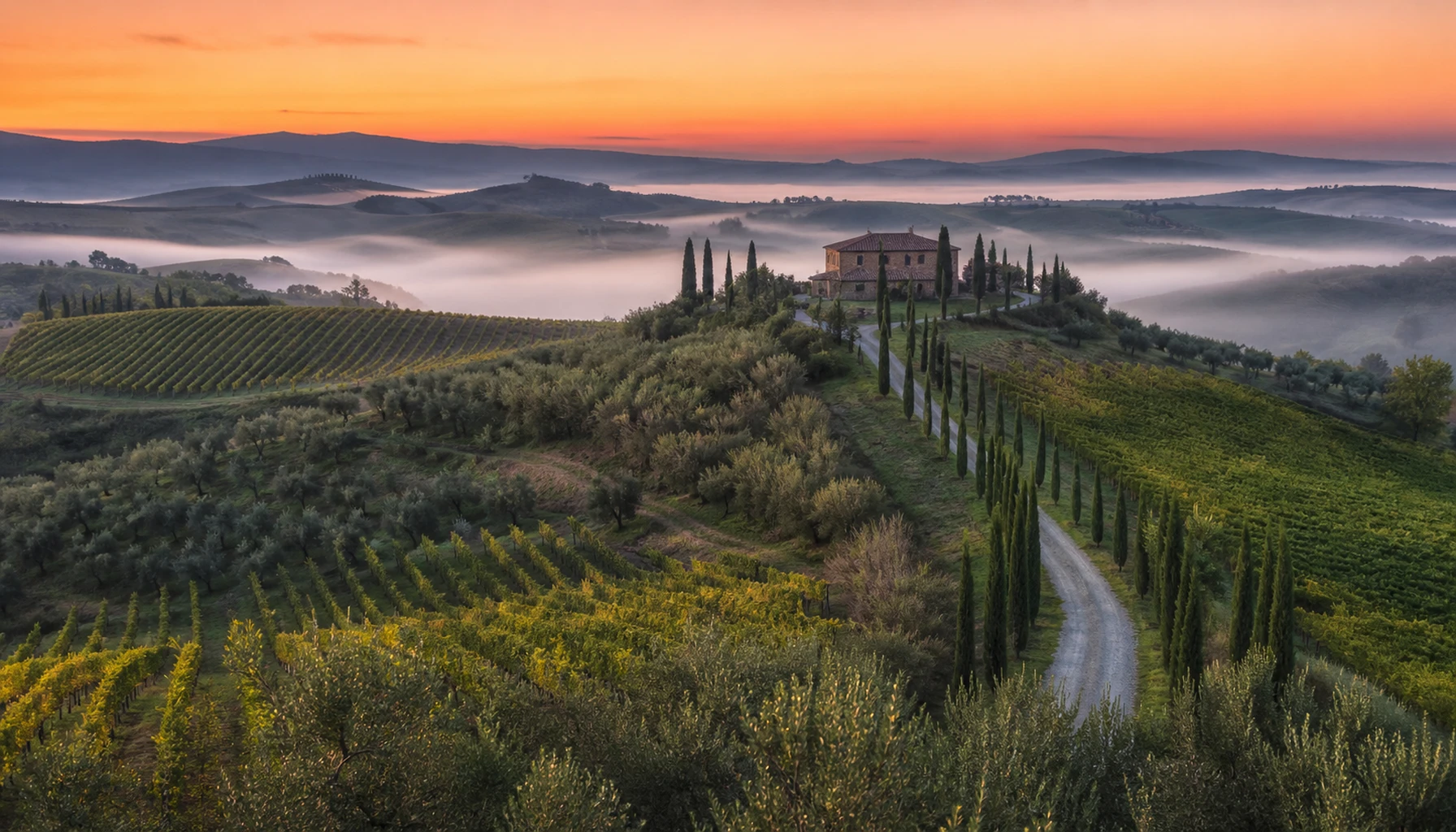
Most wine grapes keep their paperwork vague. Sangiovese’s runs deeper than most: it was familiar enough in Tuscany to be turning up in agricultural writing by the late 1500s, and the hills it grew on had been in the wine business since the Etruscans. By the time anyone thought to describe Tuscan vineyards in print, this grape was already the incumbent — less a variety someone chose than the answer the place had always given.
Its story since is really three stories — a myth in the name, a law that invented the protected wine region, and a family of clones that turned one grape into Italy’s entire top shelf — before the fourth act opens, considerably later, in a warm valley an hour from the Pacific.
The blood of Jupiter
Italy’s most planted grape, and the one its most celebrated reds cannot do without.
A god in the name
The name is usually read as sanguis Jovis — the blood of Jupiter — which tells you less about the grape’s botany than about how long Tuscans have thought it worth mythologizing. The grape itself is a demanding tenant: late to ripen, thin-skinned about weather, and honest to a fault about wherever it grows. Plant it in two neighboring vineyards and it will report the difference back in the glass — the very quality that later made it the vehicle for Italy’s most famous place-names.
The grand duke draws a line
In 1716, Cosimo III de’ Medici, Grand Duke of Tuscany, issued an edict declaring where wine sold as Chianti could legally come from — four townships, a boundary, and penalties for pretenders. It stands among the world’s first legally protected wine regions: the ancestor of every appellation system since, from France’s AOCs down to the American AVA that gave Temecula its own boundary in 1984. The idea that a wine’s name is a place, and a place can be fenced, starts more or less here — with Sangiovese inside the fence.
One grape, many masks
Tuscany then spent two centuries proving how many wines one grape could be. Chianti made it the everyday genius of the straw-wrapped flask; in Montalcino, a nineteenth-century estate began isolating a dark, thick-skinned clone and bottling it alone as Brunello — “the little dark one” — which grew into Brunello di Montalcino, one of Italy’s most exalted reds and still, underneath the reputation, a Sangiovese clone story. Vino Nobile di Montepulciano is the same grape under yet another local alias.
To California, then to the granite
Italian names are all over the early story of California wine. The Italian grapes took a little longer.
Italian immigrants helped build California wine from the nineteenth century on, but for generations they mostly planted what the market wanted rather than what their grandparents grew. Sangiovese stayed a background player until the 1980s and ’90s, when a wave of California growers went looking beyond France and began taking the Italian bench seriously — betting that a Mediterranean grape might actually prefer a Mediterranean climate.
Temecula was built for that bet. A warm granite valley at 1,500 feet, cooled every evening by ocean air through the Rainbow Gap, offers Sangiovese the same arrangement Tuscany does — heat to ripen the cherry, cool nights to guard the acid — with rather more sunshine to spend. The grape thrives here, and a handful of houses staked their whole identity on it and its benchmates: Cougar planted its vineyard for the Italian varieties and pours an all-Italian list grown on site, Robert Renzoni brings four generations of Italian instinct to the southern trail, and Mount Palomar has poured the Italian side of the cellar off plantings in the ground since 1969.
So the grape of the first fenced wine region now grows inside one of the newest. Cosimo’s edict and Temecula’s AVA are the same idea, 268 years apart — and Sangiovese, as usual, was already in the vineyard when the line was drawn.
Featured videos
The Medici edict, the Montalcino clone, the blood of Jupiter — the story, told by people who live inside it.
From Jupiter to the granite
However old the name, the wine keeps tasting-room hours — and the shortest way to the end of this story is a pour of it, somewhere on the Italian side of the valley.