Sangiovese
Chianti’s grape, translated onto California granite — sour cherry, tea leaf, and an appetite for the table no other red here can match.
Italy plants more Sangiovese than any other grape, and nearly all of Tuscany’s famous reds — Chianti, Vino Nobile di Montepulciano, Brunello di Montalcino — are this one variety wearing different cuts of the same suit. It is not a grape that shouts. Where Cabernet builds and Syrah broods, Sangiovese observes: medium weight, taut, savory, more interested in the table than in the spotlight.
The glass reads sour cherry first — ripe, but with the stone still in it — then tea leaf, dried herbs, a little worn leather, and a dusty, earthy finish. Underneath it all runs the signature: a bright, mouth-watering line of acidity that keeps every sip asking for the next one, preferably with food attached. The tannin is real but fine-grained — grip, not armor.
Tuscany and Temecula turn out to be closer cousins than the map suggests: hot, bright days, poor fast-draining soils, and a nightly drop in temperature that keeps a nervous grape’s acid intact. Here the ocean air through the Rainbow Gap works the night shift, and the valley’s extra sunshine fills the fruit out a shade riper than Chianti usually manages — cherry leaning toward black, the same snap behind it. It is the most food-hungry red on any tasting bar in the valley, and this page will not be the one to argue.
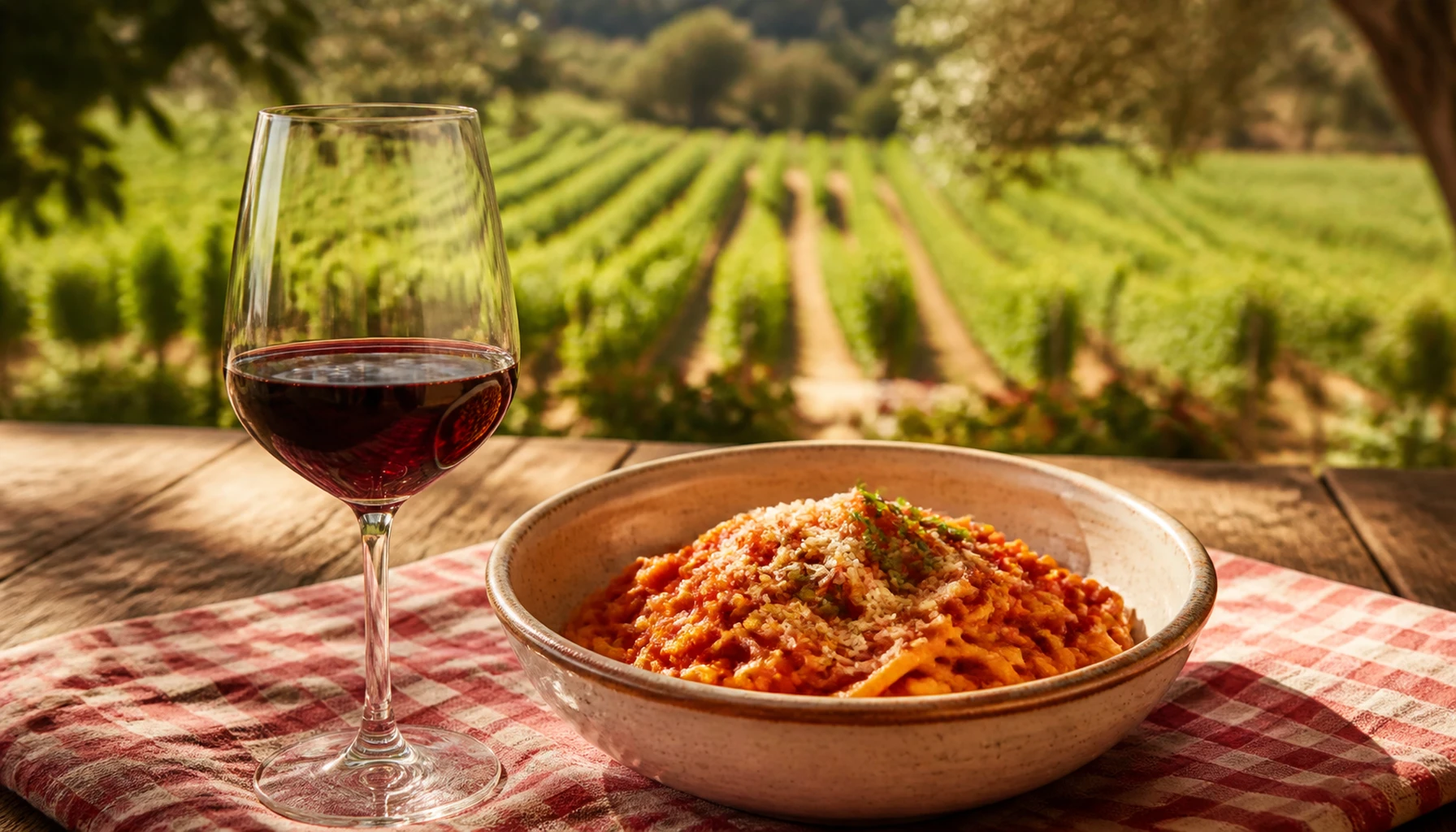
How to drink it
Acid is the engine. Give it food — or at least the idea of food — and the whole wine snaps into focus.
On a Temecula flight, Sangiovese usually lands mid-list: after the whites and the lighter pours, before the big Rhônes and the barrel monsters. Taste it there and the first impression can be that something is missing — no wall of fruit, no sweet oak handshake. Give it three seconds. What arrives instead is savor: the wine equivalent of a well-salted dish, built to sharpen an appetite rather than bury one.
Styles run a real spectrum, here as in Italy. Kept in steel or neutral barrels it stays bright, tart-cherried and quick on its feet; given time in oak it darkens, picks up cedar and sweet spice, and starts carrying itself more like its Brunello relatives. Either way the acid stays — which is why the charcuterie board on the patio stops being an accessory and becomes the second half of the pour.
| In the glass | Garnet, translucent toward the rim — a red you can nearly read through, and no less serious for it |
|---|---|
| The nose | Sour cherry, black tea, dried oregano, a little leather — savory arrives before sweet |
| The palate | Bright acid, fine dusty tannin, medium body; finishes dry, clean, and hungry |
| Serve | Cellar-cool, about 60–65°F — warmth blurs it, a light chill flatters it |
| At the table | Anything with tomato, olive oil, or crackling fat — pizza is not beneath it; pizza is the point |
Where to taste it
Three houses built their identity on the Italian grapes — and none of them treats Sangiovese as a novelty act.
Cougar made the fullest commitment in the valley: the vineyard went in for the Italian varieties, the list is all-Italian and grown on site, and there is no reassurance Cabernet waiting for the undecided. The room is informal, the owners are usually present, and the house argument — that this climate suits Italy’s grapes rather better than Bordeaux’s — is easiest to test glass by glass down the list.
On the quiet southern road, Robert Renzoni brings four generations of Italian instinct to the De Portola trail’s defining view. It is the busiest room on that road, which by De Portola standards is still calm, and if you make a single stop out there, this is the one that explains what the trail is for.
Mount Palomar has been at it longest: vines in the ground since 1969 — close to the beginning, in Temecula terms — and an Italian specialty poured off some of the valley’s oldest plantings, in a Mediterranean courtyard engineered to turn one glass into three hours. Beyond the three, Italian varieties surface on lists all around the valley; wherever you land, the question costs nothing to ask.
Featured videos
Tuscans, sommeliers and growers on Chianti’s grape — press play, pour something with acid, settle in.
The blood of Jupiter
The name is usually read as sanguis Jovis — the blood of Jupiter — and the paper trail runs through a Medici grand duke who drew a legal line around Chianti in 1716, creating one of the first protected wine regions on earth. How a grape named for a Roman god ended up on a Temecula tasting bar is a longer story, and it has its own page.