The history of the GSM blends
Before it was three initials on a Temecula tasting list, it was the house wine of the papacy — and the blueprint for French wine law.
The initials are modern — a brisk New World shorthand you will not find on any old French label — but the idea they abbreviate is medieval. Blend Grenache, Syrah and Mourvèdre in hot country and each covers the others’ weaknesses: fruit where one is stern, color where one is pale, backbone where one is soft. The southern Rhône spent centuries perfecting that treaty, and its capital has always been a village whose name is a real-estate listing: Châteauneuf-du-Pape, the pope’s new castle.
The story runs from a fourteenth-century court in exile, through a field of sun-hoarding stones, to a 1936 rulebook that changed how the world labels wine — and then across an ocean to a granite valley that keeps the same weather.
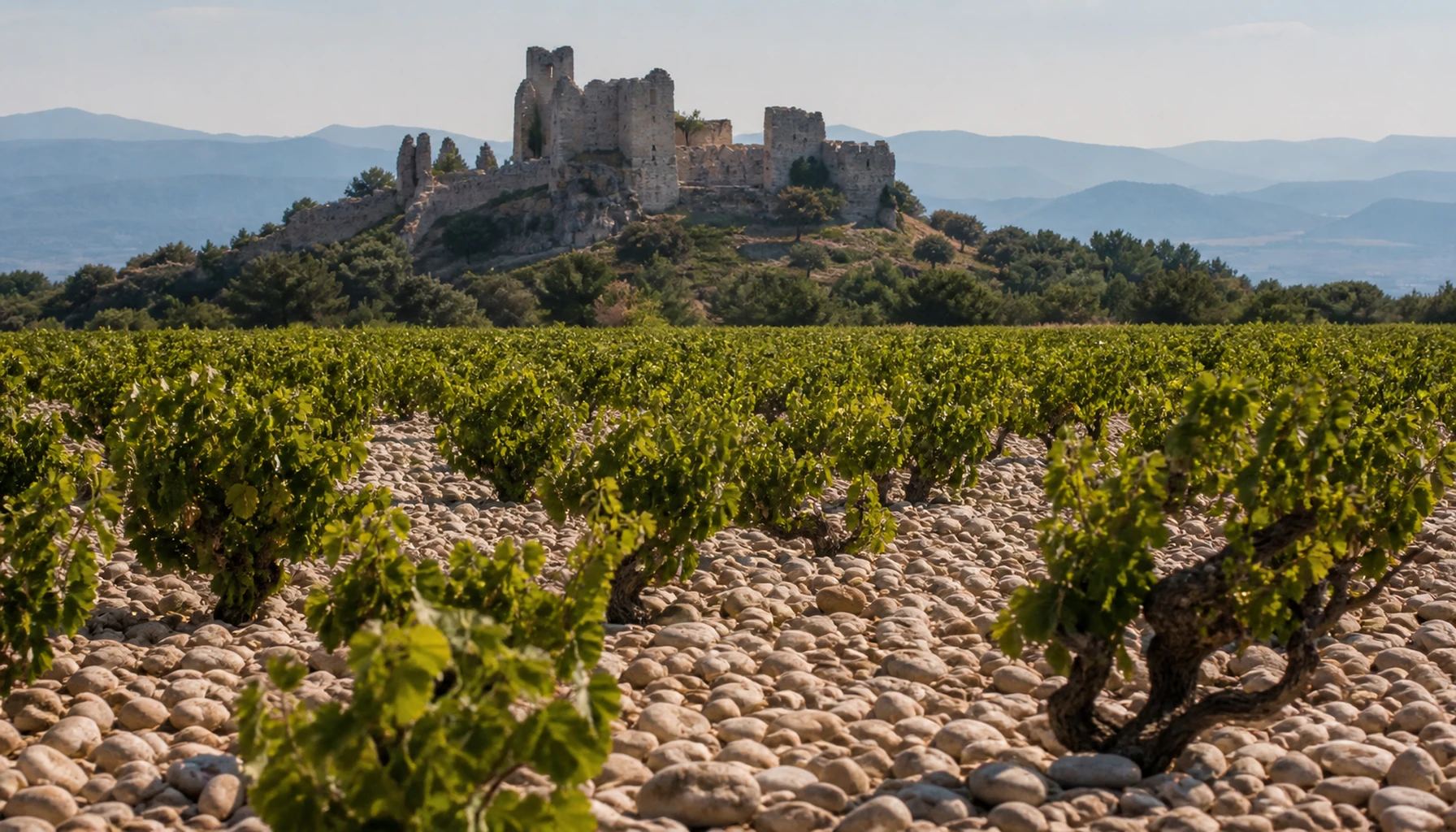
The pope’s new castle
A court in exile, a summer castle, and vineyards that answered to Rome by way of Avignon.
In the fourteenth century the papacy decamped from Rome and spent most of a lifetime ruling Christendom from Avignon, on the Rhône’s east bank. A court that size drinks seriously, and the popes of Avignon tended vineyards the way other monarchs tended armies. The hill village north of town where they kept a summer castle gave its wine country a name no marketer could improve: Châteauneuf-du-Pape. Papal patronage put the district’s wine on the grandest tables in Europe, and the reputation outlived the court by centuries.
What the popes had actually found was a freak of geology dressed as a vineyard. The ground there is paved with smooth river stones — quartz cobbles the old Rhône left behind — that soak up the day’s brutal sun and hand the heat back to the vines all night, while the mistral wind scours the air dry. It is country that will over-ripen a single grape into syrup, which is precisely why no single grape was ever asked to work it alone. The habit of blending — Grenache leading, darker and wilder grapes in support — was the place’s answer to its own climate.
1936: the blend gets a constitution
One of France’s first appellations — and a cast list over a dozen grapes deep.
By the early twentieth century, famous wine had a fraud problem: anything could be bottled under a great name and often was. Châteauneuf-du-Pape’s growers organized early, wrote down what their wine legally was — where it could grow, which grapes counted — and in 1936 the district became one of France’s first AOCs, the appellation system the rest of French wine then adopted. The paperwork enshrined the local habit: the rules admit over a dozen permitted varieties, with Grenache at the head of the table and growers free to assemble their own cast from the list.
The quiet joke in all that French law is that the lead grape is an immigrant. Grenache is Garnacha, born in Aragón in northern Spain, a vine that crossed the Pyrenees centuries before it needed French papers — and Mourvèdre is Spanish too, known at home as Monastrell. The blend the world files under the southern Rhône is really a Mediterranean compact: Spanish warmth and wildness, French discipline, one glass.
To California, to Temecula
Australia coined the initials; California made the argument; Temecula keeps the weather.
The New World took the old treaty and gave it a filing name. Australian cellars, working the same three grapes in the same kind of heat, started printing the initials on labels — GSM — and the shorthand stuck worldwide. In California, the Rhône Rangers of the 1980s made the longer case: that the state’s warm, stony hillsides were southern Rhône country wearing an American flag, and should be planted accordingly.
Temecula is that case in miniature — granite instead of river stones, the Rainbow Gap’s ocean air instead of the mistral, but the same essential deal of fierce days and relieving nights. Half the valley makes a GSM now. Miramonte has made Rhône varieties the house cause, Wiens Family Cellars built its identity on big, dark blends, and at Masia de la Vinya you can taste the lead grape solo, under its birth name of Garnacha. What the blend tastes like and how to drink it well lives on the GSM page.
Featured videos
From the popes’ vineyards to the New World rows — the blend’s long story, on film.
The short version
A court in exile planted its reputation, a field of hot stones taught it to blend, a 1936 rulebook made it law, and two Spanish grapes still do the heavy lifting. Seven centuries on, a warm granite valley in Southern California pours the same treaty by the flight — and calls it three letters.