The history of sparkling wine
The world’s most festive wine began as a fault its makers fought for a century — this is how the flaw won.
Every other wine on a tasting list was made on purpose. Sparkling wine — celebration itself, chilled and corked — began as a defect: wine that refused to stay finished, woke up in the bottle, and blew the bottle apart. Its first makers were not trying to invent anything; they were trying to make it stop.
So the story runs backwards to every expectation: cold abbey cellars, a London lecture hall, a legend pinned on a real monk, a widow’s drilled table — and, at last, a warm granite valley where three houses still make it the slow way. The glass that opens a Temecula morning carries all of it.
The devil’s wine
Cold winters stalled the ferment; warm springs woke it inside sealed bottles.
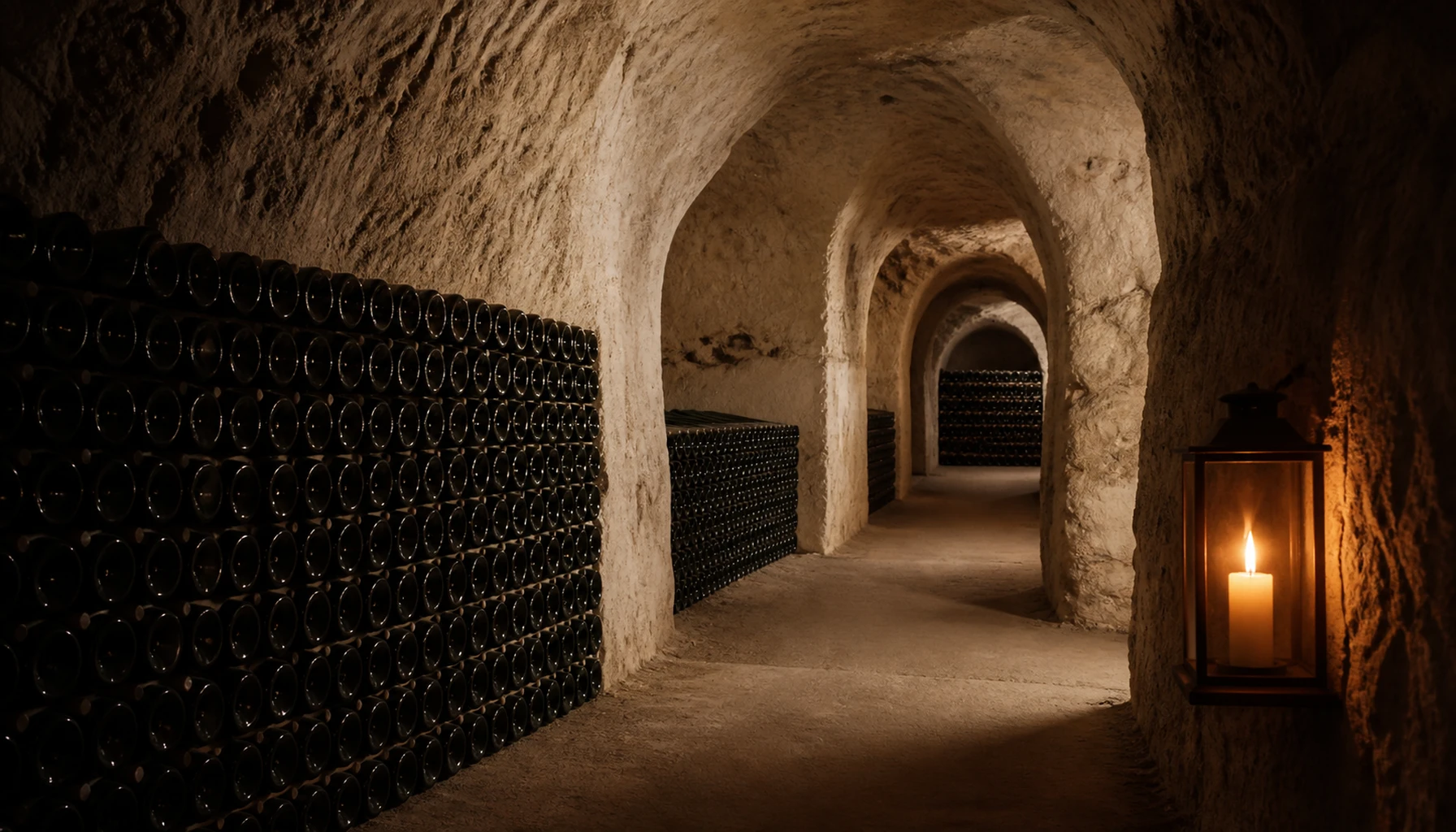
Champagne sits about as far north as serious wine can grow; its problem was the calendar. Ferments began in autumn and went winter-cold before the yeast finished; the wine fell still, seemed done, and was bottled carrying leftover sugar and sleeping yeast. Spring woke the yeast, and the gas had nowhere to go but against the glass.
The glass lost. Bottles burst in chain reactions down the stacks — cellar workers walked the rows in iron masks — and growers named the stuff vin du diable, the devil’s wine, while the region’s best cellar minds spent whole careers trying to keep the sparkle out. For most of a century, the most charming flaw in the history of drink was fought like a disease.
London’s fizz and the famous monk
England drank the fault on purpose — and wrote the method down, decades early.
The fault that embarrassed Champagne delighted London. The region shipped wine to England still, in barrel; merchants there bottled it in coal-fired English glass far stronger than French bottles, under cork that held. There the spring re-ferment ended in fizz, not shrapnel, and fashion decided the flaw was the point. In 1662 it stopped being an accident: Christopher Merret documented for the Royal Society how added sugar sets a finished wine fermenting again, “brisk and sparkling” — the method, on paper, in London.
The legend belongs instead to Dom Pérignon, cellarer of Hautvillers abbey from 1668 — and it gets him wrong by promotion. He mattered enormously: he perfected blending many plots into one wine better than any of them, and pressed black grapes gently enough to run pale juice — two pillars champagne still stands on. But he did not invent the sparkle (his job was to prevent it), and “Come quickly, I am drinking the stars” is marketing, written long after his death. Nobody invented sparkling wine: a fault, a foreign market and a century of craft did it together.
Industrializing the magic
A lucky accident becomes a repeatable luxury — then the lawyers fence the name.
The 1800s added control. In the 1810s the widow Clicquot’s cellars solved the last ugly problem — dead yeast clouding the wine — with riddling: bottles neck-down through a drilled cellar table, a small turn every day until the sediment walked into the neck. Disgorging fired it out; the dosage, a parting measure of sugar, set sweetness to order, Brut Nature through Doux. On those techniques the great houses rose, aging millions of bottles in chalk galleries beneath Champagne — cold, dark and, at last, quiet.
The final piece was legal. Champagne is a place before it is a wine; by 1936 it stood among France’s first protected appellations, and no wine grown elsewhere may borrow the name. That fence is why honest labels — Temecula’s included — read méthode champenoise or traditional method: the technique travels freely; the address stays home.
To California, to Temecula
The method crossed every ocean the vine did — and a warm granite valley does it properly.
Wherever wine went, the method followed, because celebration is not a regional taste. Rarer is a warm inland valley bothering with the full, slow version — and Temecula has three houses that do. Thornton built an entire evening around its bubbles: château courtyard, golden hour, the long-running summer jazz series. South Coast raises its sparkling in one of the region’s most decorated cellars, a resort wrapped around it. And Carter Estate, its quieter sister property, kept the bubbles and left the bustle behind — the valley’s address for sparkling without a crowd.
Here the devil’s wine even earned the morning shift: starting the day with bubbles is a legitimate local tradition, and the freshest palate you will carry all day is the reason. The valley also pours history’s least reverent footnote — Wilson Creek’s almond sparkling, its most famous single bottle, entirely unbothered by everything this page just told you. The full local case lives on the sparkling page.
Featured videos
The cellars, the monk and the méthode — the story told out loud. Press play, pour something cold, settle in.
Three centuries in one flute
A cold cellar made a fault; English glass made it survivable; a London paper made it a method; a monk made the wine beneath it great; a widow’s table made it clear; the lawyers fenced the name. A warm valley twenty-two miles from the Pacific now pours the whole inheritance before noon — and every bubble in a Temecula flute climbs through that story.